
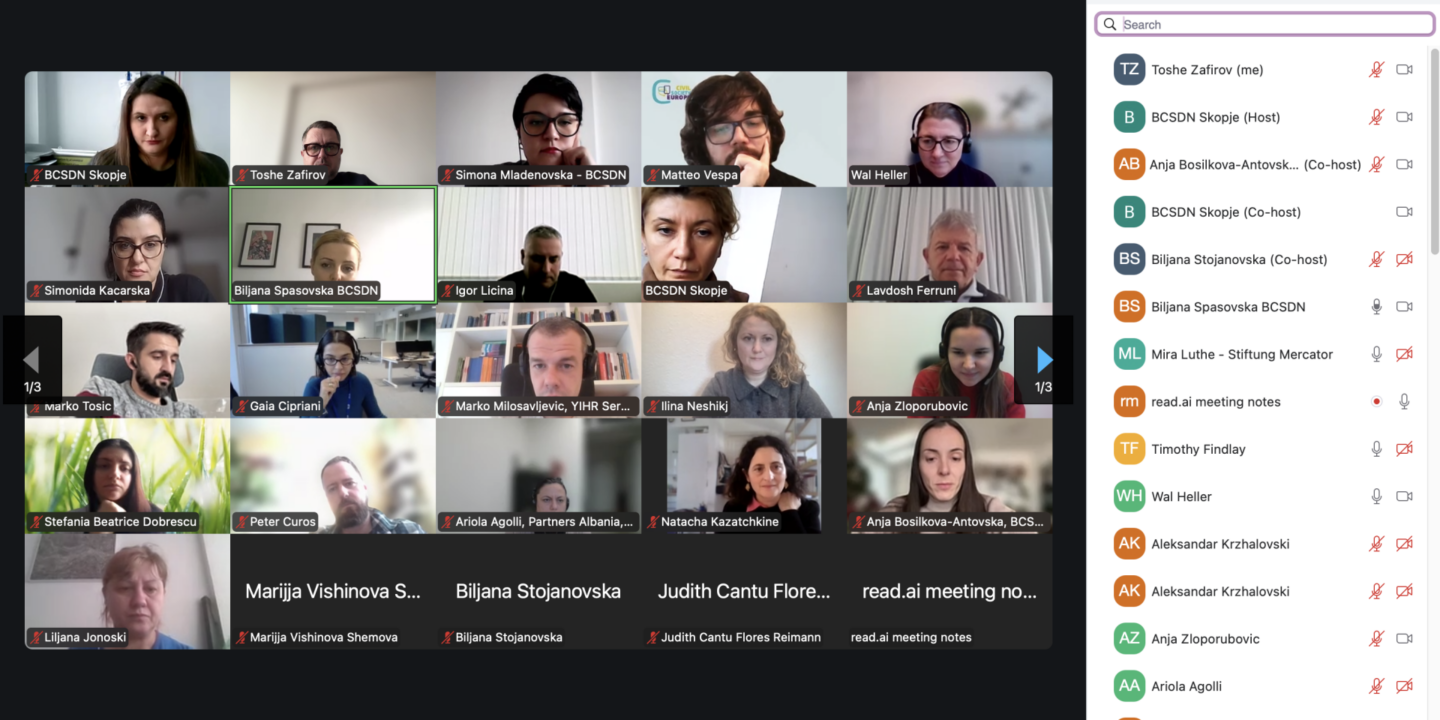
Reflections from an online roundtable: BCSDN Conversations: The Consequences and Impact of the EU’s Democracy Instruments and Polices on the WBT Civic Space
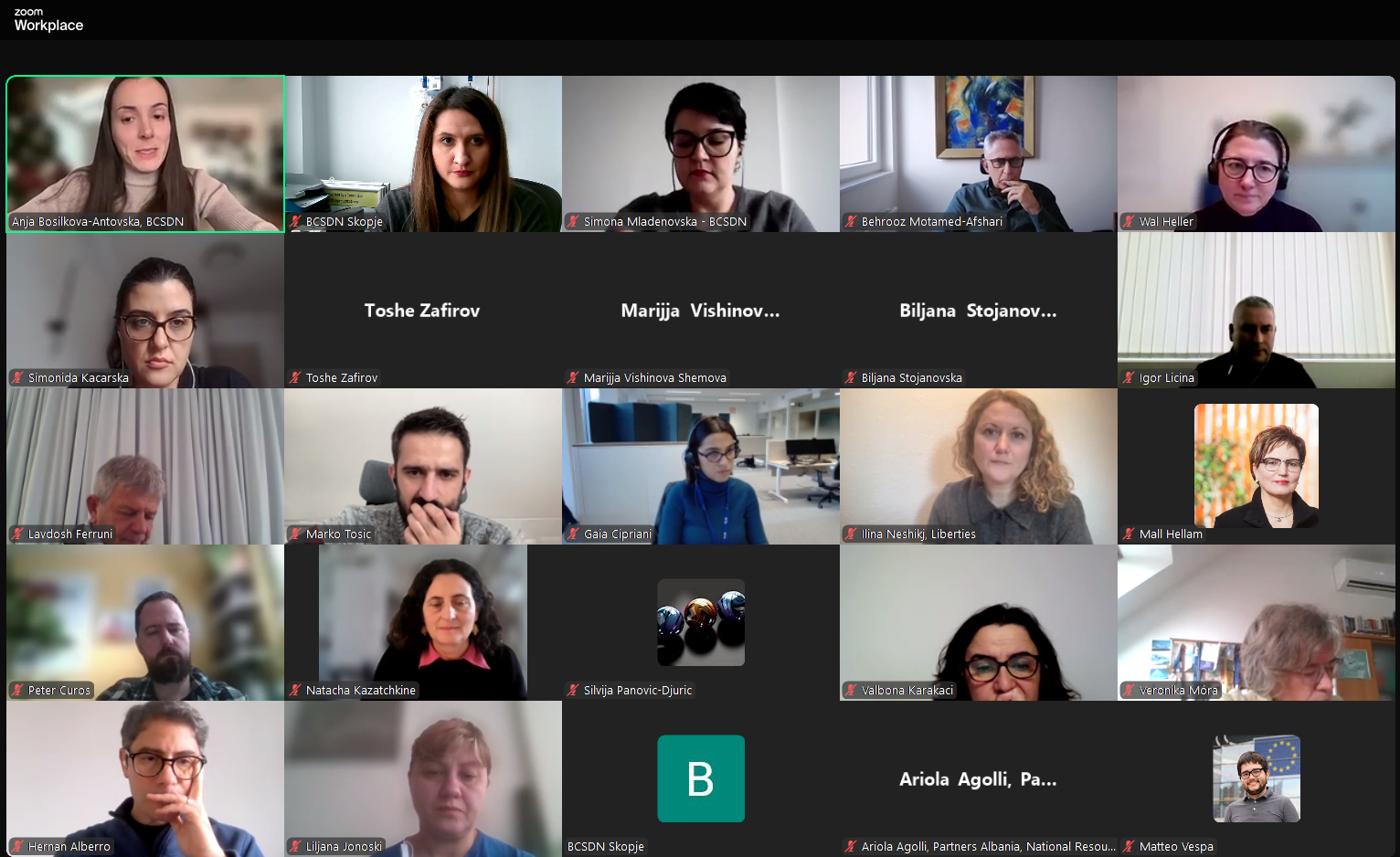
Amid heightened geopolitical uncertainty and sustained pressure on democratic norms across EU and its neighbourhood, the EU is reassessing its approach to democracy, enlargement, and civic space. In this context, Ms. Biljana Spasovska, BCSDN Executive Director, framed the discussion around the EU’s new democratic instruments—the EU Civil Society Strategy, the European Democracy Shield, and the forthcoming 2028–2034 Multiannual Financial Framework (MFF), highlighting both their potential and the and the risks posed by parallel security, driven debates and funding approaches shaped by compliance requirements. With key elements still under development, the discussion highlighted this as a critical moment for civil society in the Western Balkans and Türkiye to be included in the implementation of these instruments.
New EU Instruments: Implications for Enlargement Countries
The EU Civil Society Strategy and the emerging European Democracy Shield highlight participation, protection, and funding for civil society for EU members and Enlargement countries, while also raising concerns about how security and resilience narratives, funding design, and implementation choices could be misused in ways that restrict civic space.
“The EU Civil Society Strategy frames civic space as a shared concern across the EU and enlargement countries, formally integrating enlargement context into the EU’s civic space framework and strengthening the basis for engaging civil society in EU democracy processes.” Waltraud Heller ( Fundamental Rights Agency, FRA)
 Ms. Wal Heller from FRA outlined how the EU Civil Society Strategy translates this shift into practice through three core pillars- engage, support and protect, each supported by concrete mechanisms relevant for civil society in enlargement countries. She highlighted a range of actions enabling civil society engagement, including continued monitoring and reporting on civic space, the development of a civic space indicator framework, the creation of an online civic space information hub under FRA, and the establishment of new dialogue and networking mechanisms. These include a forthcoming Civil Society Dialogue Platform, national civic space dialogues piloted by FRA, and two dedicated networks—one on monitoring (led by FRA) and one on protection (led by OHCHR), both open to participation from enlargement countries CSOs.
Ms. Heler explained the Strategy also points to a number of measures with potential relevance for enlargement countries, such as capacity building, funding, donor dialogue, civic space impact assessments, and access to pro bono legal support. Two actions are explicitly tailored to enlargement countries: strengthening early warning systems to detect emerging civic space restrictions, and the involvement of civil society in the enlargement process—both offering meaningful leverage only if civil society is engaged strategically from the outset in their design and use.
 Ms. Natacha Kazatchkine, Secretary General of the European Civic Forum, noted that while the EU Civil Society Strategy adopts an enabling, rights-based approach, the European Democracy Shield is taking shape in a more defensive, security-driven context. She cautioned that narratives centred on foreign interference and resilience risk shifting policy design toward control, surveillance, and the policing of civic space, rather than its protection and expansion. Referring to debates around third-country lobbying rules and growing political attacks on NGO funding, she warned of the risk that restrictive approaches could become normalised at EU level and later transposed into enlargement countries. At the core of this risk, Kazatchkine underlined, is a reversal of the logic of democratic protection: instead of shielding citizens from injustice and rights violations, security-driven approaches may frame democracy as something that must be protected from “disloyal” actors, critical voices, or alleged foreign influence. In enlargement countries, where similar narratives have already justified restrictive laws, this inversion carries particularly high spillover risks, reinforcing the need for early and active civil society engagement.
 Building on warnings about security-driven approaches and spillover risks, Ms. Ilina Neshikj, Executive Director of Liberties, argued that the EU continues to treat democracy as self-sustaining rather than as a shared democratic infrastructure requiring sustained political commitment and targeted investment—particularly in contexts of rule of law backsliding. She highlighted a persistent gap between the EU’s political language on democracy and civic space and the design of funding and instruments in practice, noting that many approaches still assume stable environments and cooperative governments. She underlined the need for funding models independent from national governments, expanded core and multiannual support, and a shift toward protection-oriented approaches—including emergency support, legal and digital security assistance, and political backing for organisations under attack—while noting that there is currently no EU-wide protection mechanism for civil society inside Europe. Neshikj also pointed to the lack of dedicated EU funding for strategic litigation, stressing that courts often remain the last line of defence for fundamental rights, yet legal action is rarely supported beyond basic capacity building.
“If democracy instruments do not prioritise independence, protection, and enforcement, the EU risks managing democratic decline rather than reversing it—especially as democracy is increasingly framed through a security and resilience lens.”Ilina Neshikj, Civic Liberties Union of Europe (Liberties)
Resourcing for Democracy Amid Tightening Civic Space
As the EU prepares its 2028–2034 funding framework, civil society in the Western Balkans faces a restrictive environment. Despite stronger recognition of democracy and civic space in EU discourse, funding is becoming more consolidated, conditional, and security-informed, raising questions about independence, sustainability, and meaningful participation.
Mr. Matteo Vespa, Policy and Project Officer at Civil Society Europe, outlined how the 2028–2034 Multiannual Financial Framework is set to reshape EU funding for civil society, while leaving many key priorities dependent on implementation choices rather than clearly anchored in legislation. He highlighted that under the proposed Global Europe instrument, existing funding streams for enlargement countries—including IPA and the Western Balkans Reform and Growth Facility—would be consolidated into a single framework, grouping enlargement and neighbourhood countries together and reducing the visibility of a dedicated Western Balkans envelope. While the regulation includes references to civil society participation, enabling environments, and support for independent media and reform monitoring, Vespa cautioned that advocacy is not explicitly covered in the legal framework and remains subject to Commission discretion. He further warned that increased conditionality—particularly linked to migration—and the absence of clear guarantees for advocacy and long-term funding create significant uncertainty for civil society in the region.
 Ms. Juliana Hoxha, Executive Director of BCSDN member Partners Albania, highlighted the widening gap between EU-level commitments and realities on the ground, noting that in Albania—despite its status as an accession frontrunner—civic space and sustainable funding for civil society have deteriorated rather than improved, with funding cuts often justified precisely by this “frontrunner” status. She pointed to the prolonged absence of a national civil society strategy and the ongoing dismantling of the only public body established to fund civil society as clear signs of backsliding that contradict the logic of the EU Civil Society Strategy. Hoxha stressed that while the Strategy is not legally binding and does not deliver immediate material change, it increases the political weight of reporting, Growth Plan assessments, and human rights monitoring, raising the political cost of backsliding through conditionality. She underlined that participation is becoming more formalised and evidence-driven—shifting expectations toward co-design and accountability while also risking the exclusion of smaller organisations—making coalition-building increasingly necessary. Turning to the MFF, she warned that the absence of a dedicated enlargement envelope and clear civil society allocations, combined with a shift toward Growth Plan–based conditional funding, risks weakening oversight, lowering reform quality, and undermining accountability if independent civil society is not meaningfully involved.
 Ms. Simonida Kacarska, Director of European Policy Institute (EPI), built on Juliana Hoxha’s analysis by placing the discussion in a regional perspective, drawing on hands-on experience with EU-funded monitoring of national reform agendas and civil society participation in Growth Plan. She stressed that the scale, technical complexity, and pace of new EU instruments far exceed the current capacity of civil society, particularly given compressed timelines and a prolonged period of crisis management that has left little room for strategic preparation. While the EU Civil Society Strategy marks an important shift by treating civic space in Member States and candidate countries within a shared framework, Kacarska cautioned that its impact will depend on whether it is operationalised through coherent rule-of-law conditionality across countries, rather than remaining declaratory. She identified weak regional networking among candidate countries as a major gap, driven in part by funding models that incentivise fragmentation over cooperation. Finally, she warned that the unresolved tension between democratic resilience and securitisation—also present in the Democracy Shield—poses particular risks for enlargement countries, underscoring the need for an empowering approach that expands civic space rather than managing or restricting it under security narratives.
Ultimately, the EU’s new democratic instruments represent a critical juncture for the Western Balkans, offering stronger integration into EU civic frameworks alongside significant risks from securitized narratives and funding consolidation. While the EU Civil Society Strategy provides a rights-based foundation for engagement and protection, its success depends on moving beyond declaratory language toward enforceable conditionality and sustained support for independent advocacy. To prevent democratic backsliding, civil society must be strategically involved in the design and oversight of these instruments to ensure they expand, rather than restrict, civic space.
As a regional network working to protect and expand civic space and fundamental rights, BCSDN reaffirmed its commitment to evidence-based monitoring, early warning, and sustained dialogue with EU institutions to ensure that emerging democracy instruments strengthen, rather than restrict, civic space in the region. Through our Monitoring Matrix and early-warning work, BCSDN aims to ensure that civic space is treated not as an abstract value, but as measurable, protected, and politically consequential.
Background reading:
- BCSDN Welcomes the First-ever EU Strategy for Civil Society with Calls for Stronger Enlargement Focus
- Transparency Without Stigmatisation: Safeguarding Civil Society in the EU’s Third-Country Lobbying Directive