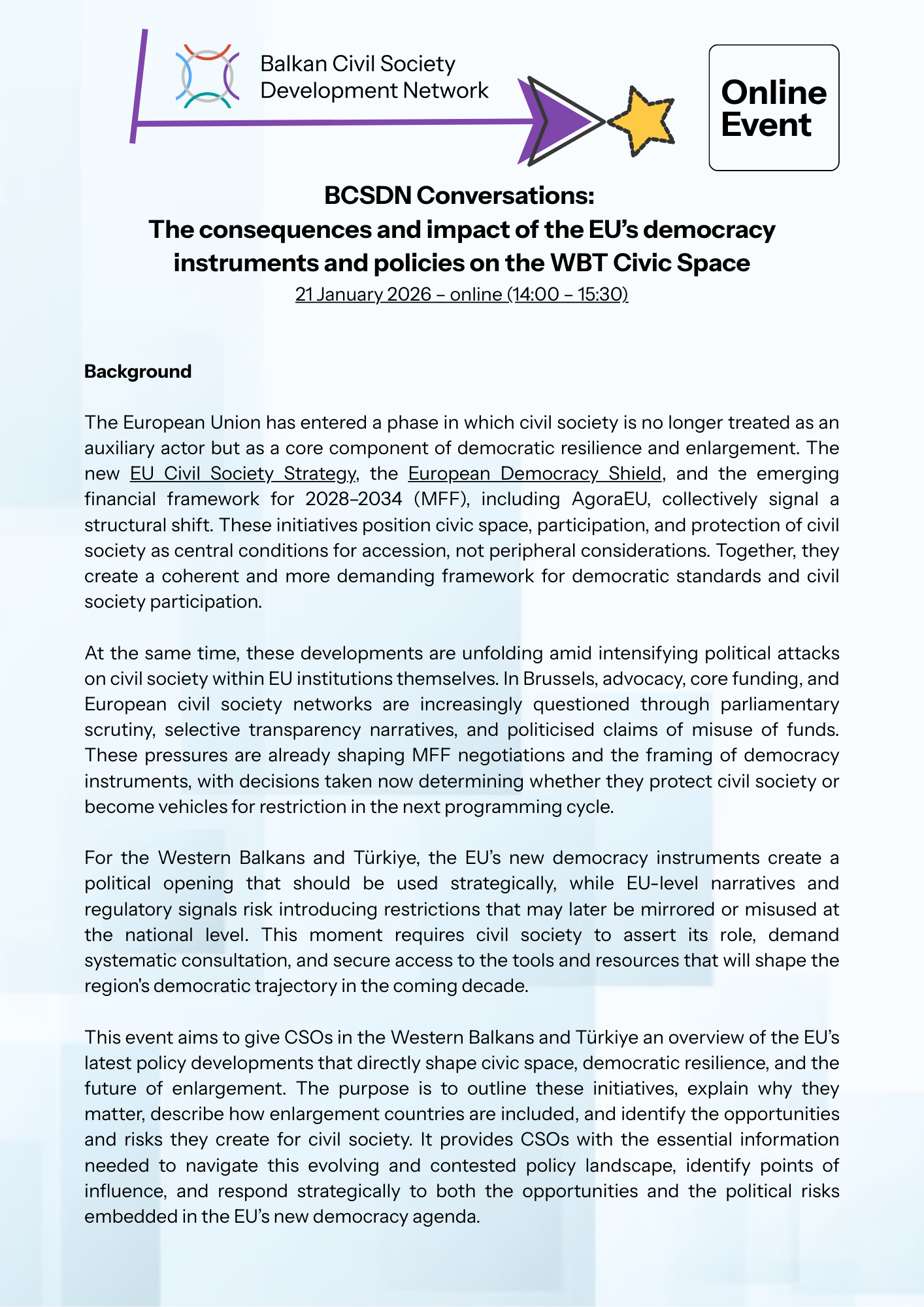
21 January 2026 | 14:00–15:30 | Online | Zoom registration link available HERE
What do the EU Civil Society Strategy, the European Democracy Shield, and the emerging financial framework for 2028–2034 (MFF), including AgoraEU, mean for civic space in the Western Balkans and Türkiye?
Are they opening space for stronger participation, or creating new risks that could later be mirrored or misused at the national level?
As the EU places civic space, participation, and protection of civil society at the centre of democratic resilience and enlargement, key policy choices are being made. At the same time, political pressure on advocacy, funding, and civil society actors is intensifying, including within EU institutions. Decisions taken now will shape whether EU democracy instruments strengthen civil society or become tools of restriction in the next programming cycle.
A turning point: What role can civil society play now?
This online roundtable offers a focused overview of the EU’s latest democracy instruments and policies and how they affect enlargement countries. It aims to help CSOs understand how the Western Balkans and Türkiye are included, what opportunities and risks are emerging for civic space, participation, and funding, and where civil society can engage strategically. The discussion will also explore how civil society can intervene early in EU policy processes to prevent restrictive spillovers and secure meaningful participation. It is designed primarily for CSOs, networks, and policy actors working on democracy, rights, and civic space in the region.
Two roundtables, One strategic moment
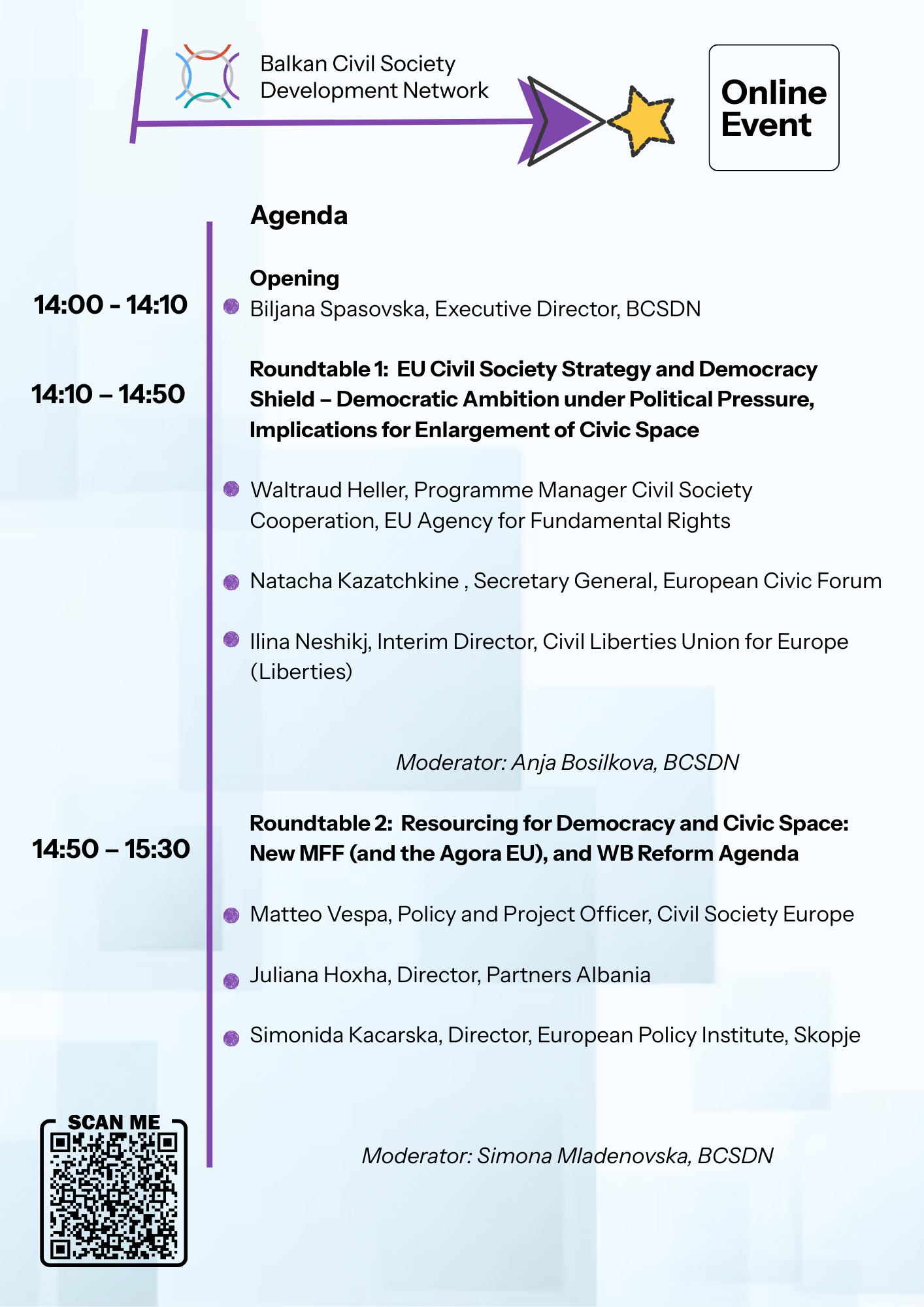
The discussion is organised around two roundtables. The first examines the EU Civil Society Strategy and the Democracy Shield and their implications for civic space under growing political pressure. The second focuses on resourcing democracy, examining the new MFF, AgoraEU, and the Western Balkans Reform Agenda, and what they mean for the sustainability and protection of rights-based CSOs
Speakers include representatives of EU institutions, EU agencies, the European Parliament, and European and regional civil society organisations, including BCSDN members.
Zoom registration link available HERE.
For more details, please consult the BACKGROUND NOTE and AGENDA.