
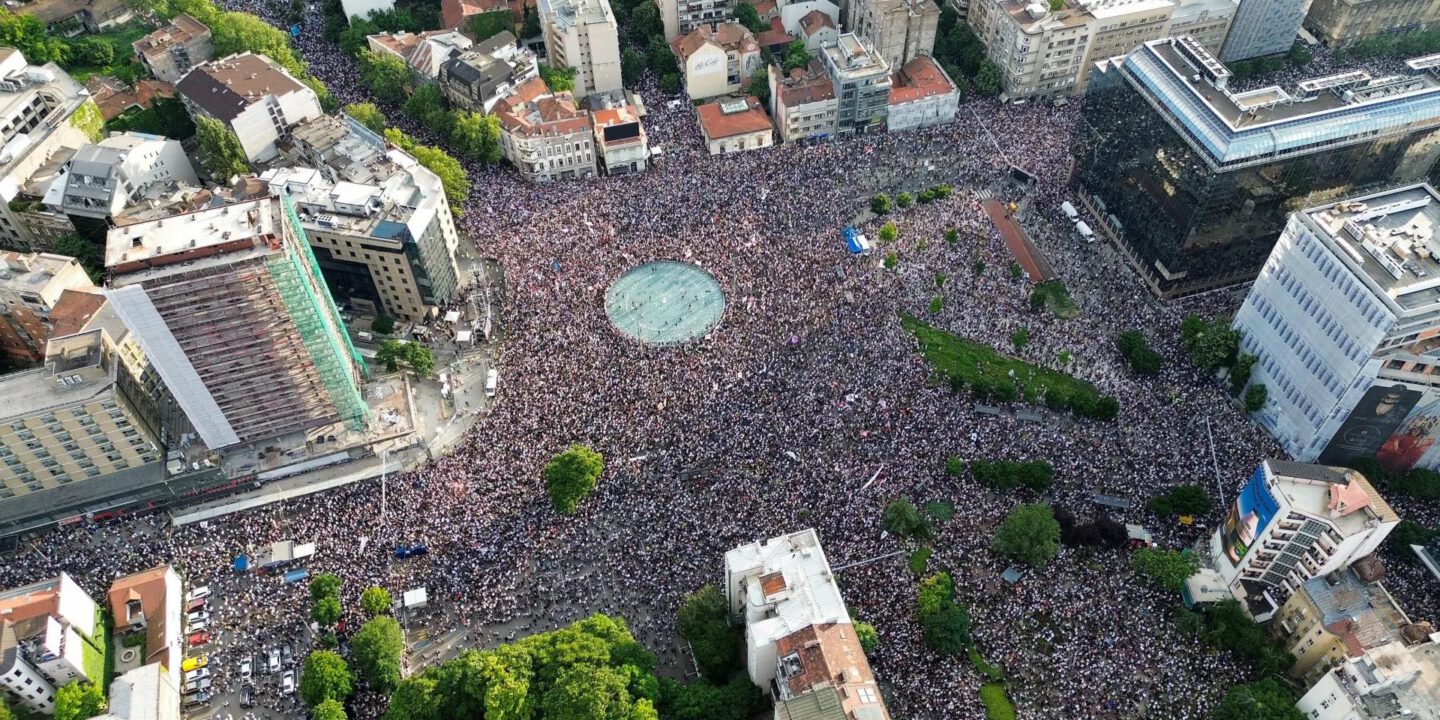
Photo: A drone view of demonstrators attending a student-led protest demanding snap parliamentary elections in Belgrade, Serbia on May 23 [Djordje Kojadinovic/Reuters]
BELGRADE / SKOPJE — The latest mass mobilizations across Serbia have sent an unmistakable shockwave through the Western Balkan region. This past weekend, over 100,000 citizens and student-led networks completely took over Slavija Square in Belgrade, with independent estimates putting the total gathering between 180,000 and 190,000 people. What began as raw public grief and a localized demand for institutional accountability following the Novi Sad railway station tragedy has officially transformed into a unified, society-wide democratic defense.
For the Balkan Civil Society Development Network (BCSDN) and defenders of civic space across the region, the events unfolding in Serbia offer a masterclass in building organic democratic resilience—while simultaneously sounding a sharp alarm on the dangerous legal and rhetorical tactics states deploy when a civic movement becomes too big to ignore.
The Power of Sustained Momentum: Beyond Spontaneous Protest
Democratic pressure often relies on time as a structural weapon—assuming that fragmentation, activist exhaustion, or prolonged state stonewalling will gradually drain public energy. Yet, the current dynamic in Serbia proves the exact opposite. The movement has transitioned from spontaneous mass street blockades into a value-driven, highly organized civil disobedience front.
The strategy is clear: momentum is being systematically built up, not worn down. By moving past the initial shock of the tragedy, university students, labor unions, agricultural workers, and academic staff have formed a cross-sectoral alliance. Part of this resilience lies in its decentralization; keeping the focus entirely on institutional accountability and the rule of law rather than identifiable political personalities has made the movement strategically resilient and incredibly difficult for the regime to target, co-opt, or politically discredit.
A Regional Turning Point: Youth, Nationalism, and the Fight for Western Balkan Civic Space
Developments in Serbia cannot be observed through an isolated domestic lens; they sit at the absolute core of the struggle for civic space across the Western Balkans.
Recent regional youth research from late 2025—including findings presented by “BSC Young Leaders” on Generation Z in the region—explicitly highlights that widespread populist corruption, historical revisionism, and state-manipulated nationalism are the primary obstacles to freedom and regional cooperation. Historically, autocrats in the Balkans have ruled by manufacturing ethnic and national divisions to fragment public dissent.
Serbia’s current student-led movement is structurally breaking this cycle. By placing universal democratic values—transparency, human rights, institutional integrity—at the center of their defiance, they are actively bypassing state-engineered polarization. They are demonstrating that youth are not mere bystanders, but active architects capable of changing populist narratives in a fragile region.
BCSDN’s Monitoring Matrix has long documented how civic space in the region narrows gradually rather than through single, dramatic events—often normalized via smear campaigns, restrictive legal amendments, and the systematic delegitimization of critical voices. If the civic space in Serbia is successfully downgraded and criminalized, a highly dangerous precedent is set for the entire Western Balkans.
Dismantling the State Narrative: Violence, Fabricated Nationalism, and Legal Retaliation
As the civic front expands, so do state-engineered attempts to systematically shrink civic space and change the subject. Local watchdogs, including our partners at Građanske inicijative (Civic Initiatives), have issued urgent warnings regarding the state’s strategic counter-narratives over the weekend:
- The “Violence” Spin: While the core program at Slavija Square was completely peaceful and diverse, state-controlled media hyper-focused on minor, isolated post-protest flashpoints to label the entire civil disobedience movement as “violent border rioters.”
- The “Nationalism” Card: In an effort to alienate international observers and split the domestic front, the regime has weaponized fabricated accusations of radical nationalism against youth organizers, purposefully steering the public narrative away from state corruption and institutional capture.
- Criminalizing Accountability: Most alarmingly, the state is utilizing legal tools—including impending, highly restrictive amendments to the Criminal Code—to turn basic constitutional rights like peaceful assembly and environmental road blockades into criminal offenses labeled as “political retaliation.”
Despite intense police presence, administrative intimidation, and arbitrary detentions, local institutional solidarity is keeping the movement insulated from state-engineered fear. Mechanisms like the local ŠTIT (SHIELD) protection framework are working 24/7 to provide immediate legal, psychological, and physical defense for targeted youth and frontline activists.
Europe is Watching: Civic Space is Not a Technical Benchmark
As political actors across Europe—including the Socialists & Democrats, the European Greens, and the European Democratic Party—express growing solidarity, the message from Western Balkan civil society remains firm: Civic freedoms and accountability mechanisms are not optional technical checkboxes for EU integration; they are the foundation of democratic credibility.
The line between an “obstructed” civic space and an openly “repressed” state has been brought to the forefront in Belgrade. The historic mobilization currently underway proves that democratic decline across the Balkans is neither inevitable nor irreversible. Citizens and youth are holding the line for a progressive, transparent future. The only question that remains is whether regional and international institutions are genuinely prepared to stand with them.
BCSDN will continue to closely monitor the situation on the ground alongside our local partners, advocating for the absolute protection of the freedom of assembly and the shielding of independent civic voices across the region.