

Why do citizens continue to mobilise in Serbia, despite mounting pressureand months of uncertainty? In this op-ed, Alma Mustajbašić from BCSDN member organisation Civic Initiatives explores the evolution of the protest movement, the challenges surrounding civic participation, and the wider lessons for democracy and civic space in the region.

More Than Numbers: Why Citizens Continue to Mobilise in Serbia
The 23 May protest in Belgrade confirmed that Serbia’s civic mobilisation is not losing momentum. Independent estimates suggested between 180,000 and 190,000 citizens gathered in Slavija Square, while official figures communicated significantly lower numbers. Yet debates over crowd size risk overshadowing the more important political reality– what began following the Novi Sad tragedy and demands for accountability has evolved into one of Serbia’s largest civic mobilisations in recent history.
Workers, professors, farmers, lawyers, trade unions, and citizens from across Serbia increasingly recognise their own concerns in demands for accountability, institutional responsibility, and transparent governance. Despite expectations that time, fatigue, or uncertainty would weaken momentum, the protests continue to attract broad societal support and show signs of growing political articulation.
“The last protest in Slavija Square can be seen as the first major pre-election rally of students and citizens, where speakers mapped the problems in education, agriculture, and labour rights. It also showed that the student movement is slowly but surely evolving into an organised political actor with an increasingly articulated political programme.”— Alma Mustajbašić, Civic Initiatives
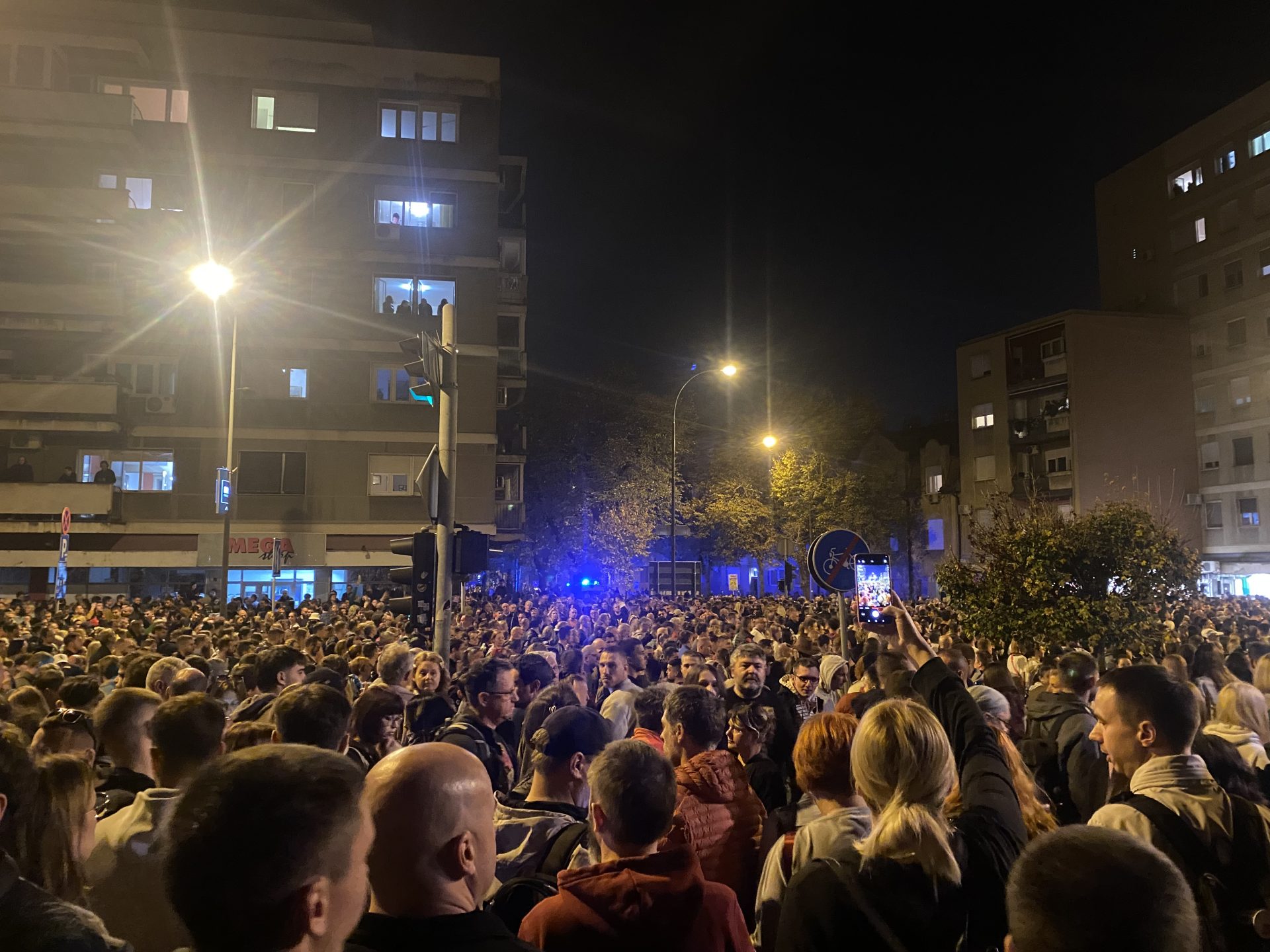 Commemoration in Novi Sad marking one year since the collapse of the railway station canopy on 1 November 2024, which claimed 16 lives and became a symbol of demands for accountability and justice.
Battle Over the Narrative: When Accountability Gets Reframed
Throughout the official programme, student organisers emphasised peaceful participation and actively sought to prevent tensions or provocations.
Roughly thirty minutes after the programme concluded, when many participants had already begun leaving the area, incidents involving masked individuals and clashes with heavily deployed police units rapidly redirected public attention away from accountability demands and one of Serbia’s largest civic mobilisations in recent history toward narratives centred around violence and instability. Riot police interventions, reports of detentions and footage spreading across media and social networks quickly came to shape public discussion more than the protest’s original messages. “While the students publicly distanced themselves from the masked individuals linked to the violence, the authorities’ response raised serious concerns. Police deployed armoured vehicles, used force indiscriminately, and detained people beyond those directly involved in the incidents, further deepening concerns about the protection of fundamental freedoms,” says Alma Mustajbašić of BCSDN member Civic Initiatives.
The shift itself matters. As support for Serbia’s protests expands, so do efforts to redefine what they represent. State-controlled narratives focus on isolated incidents to portray broader civic mobilisation as violent, while accusations of nationalism, destabilisation or foreign influence continue appearing as tools to discredit student organisers and critical voices. Concerns around legal pressure and institutional response further raise broader questions around democratic participation itself — and the risk that accountability demands become reframed as instability.
Why Students Changed the Political Equation
A key factor behind the movement’s resilience is its student-led, grassroots structure. Unlike protest movements organised around identifiable leaders or opposition structures, students developed a decentralised and collective model that made mobilisation harder to personalise, politically target or discredit. At a time of fragile trust in political actors, keeping focus on demands rather than personalities appears less like organisational weakness and more like strategic resilience.
“By practising direct democracy through plenums, students created a space where every voice mattered and collective decisions were made together. This strengthened identification with the movement and, as the model expanded to citizens’ assemblies, contributed to higher levels of civic participation and local engagement,”- Alma Mustajbašić
Yet the movement’s very structure increasingly raises broader political questions around what comes next. As European Parliament Rapporteur for Serbia Tonino Picula recently argued, student movements and pro-European opposition should not be rivals, but complementary parts of a broader democratic effort. The discussion extends beyond Serbia itself, reflecting wider debates across Europe around how civic mobilisation eventually translates into longer-term political change — including through examples such as Hungary and the emergence of Péter Magyar as a political alternative.
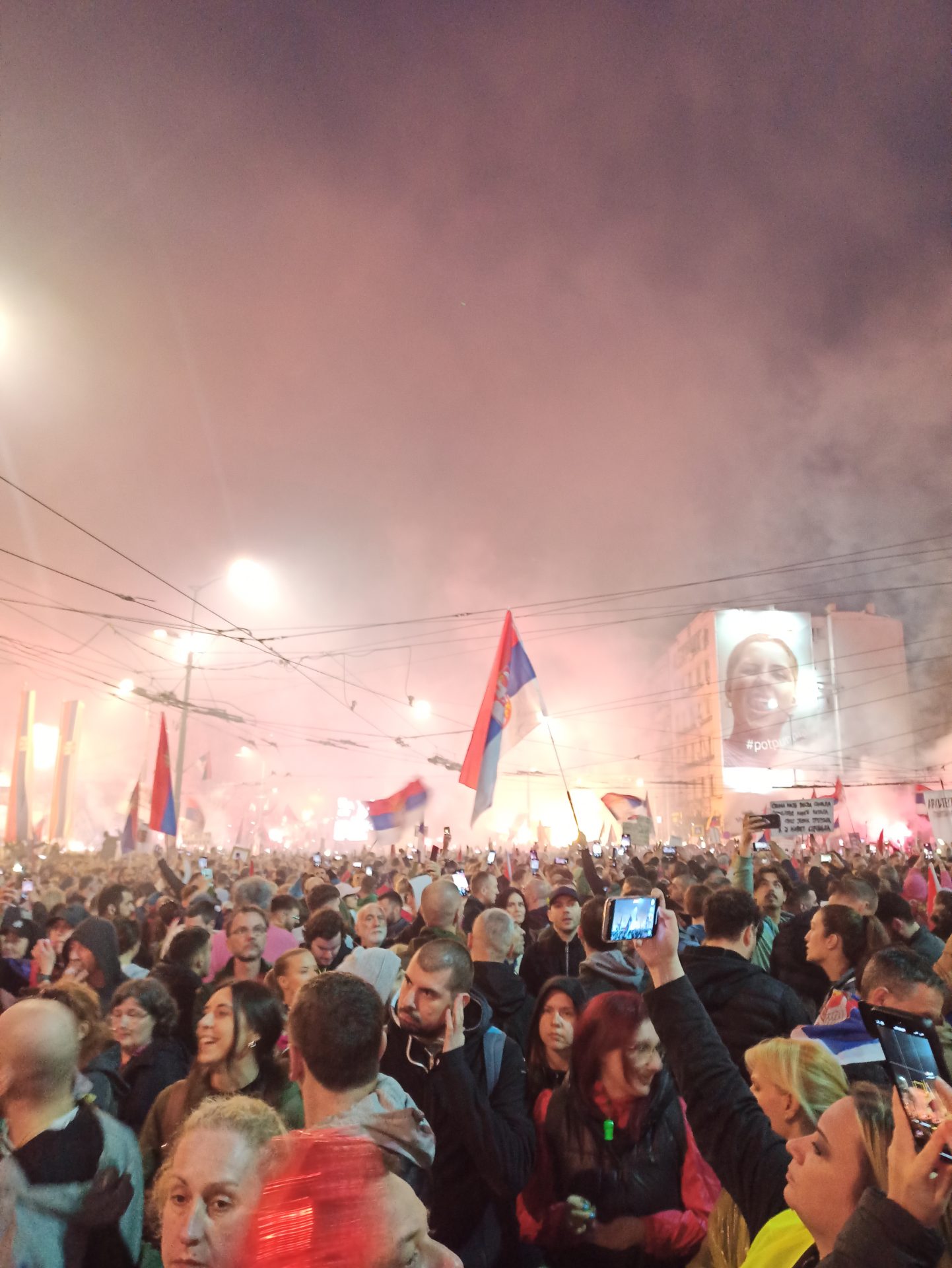 Crowds gathered at Slavija Square during the 15 March 2025 protest in Belgrade. During the evening’s 16-minute silence, reports emerged of the use of a sound cannon, causing panic, a mass stampede, and injuries among participants.
What Serbian Civic Mobilization Reveals About Civic Space in the Region
The developments unfolding in Serbia reflect wider patterns affecting civic space across the Western Balkans. BCSDN’s Monitoring Matrix has for years documented trends ranging from delegitimising critical voices and weakening meaningful participation while preserving procedural consultation, to growing pressure against accountability actors and democratic space gradually narrowing through measures that become normalised over time.
Restrictions affecting civic participation rarely emerge all at once. More often, they develop gradually through smear campaigns, foreign influence narratives, pressure against independent actors, restrictions affecting assembly and expression, or participation mechanisms that formally exist but struggle to translate into meaningful influence.
This is precisely why Serbia matters regionally. At a moment of fragile democratic trust across the Western Balkans, Serbia’s protests demonstrate that demands around accountability, transparency and functioning institutions continue carrying significant societal power — particularly among younger generations increasingly refusing political apathy, polarisation and nationalist narratives as the region’s political default. What began as a reaction to tragedy increasingly reflects something broader: not only a protest movement, but growing societal demands for political accountability, institutional change and transparent elections as a pathway toward democratic renewal.
Europe Is Watching. Citizens Are Too.
Reactions from international civil society actors, the Council of Europe Commissioner for Human Rights, and political groups across Europe, including the Socialists & Democrats, European Greens, and European Democratic Party, signal growing alarm over the state of civic freedoms and democratic governance in Serbia.
As developments continue to unfold, BCSDN remains closely engaged in monitoring civic space developments and amplifying concerns through its regional advocacy and rapid- alerts. At the same time, local partners remain at the forefront of the response. In Serbia, Civic Initiatives, through the ŠTIT (SHIELD) protection mechanism, continues to provide legal and physical support to students, activists, and citizens facing pressures. As mobilisation continues, these support structures, among others, remain essential for documenting violations, responding to incidents, and offering timely support to those affected.
In a region shaped by democratic fatigue, polarisation and shrinking civic space, Serbia’s students continue reminding both institutions and Europe of something fundamental: democratic resilience does not disappear simply because pressure grows stronger. Sometimes, it grows stronger too.
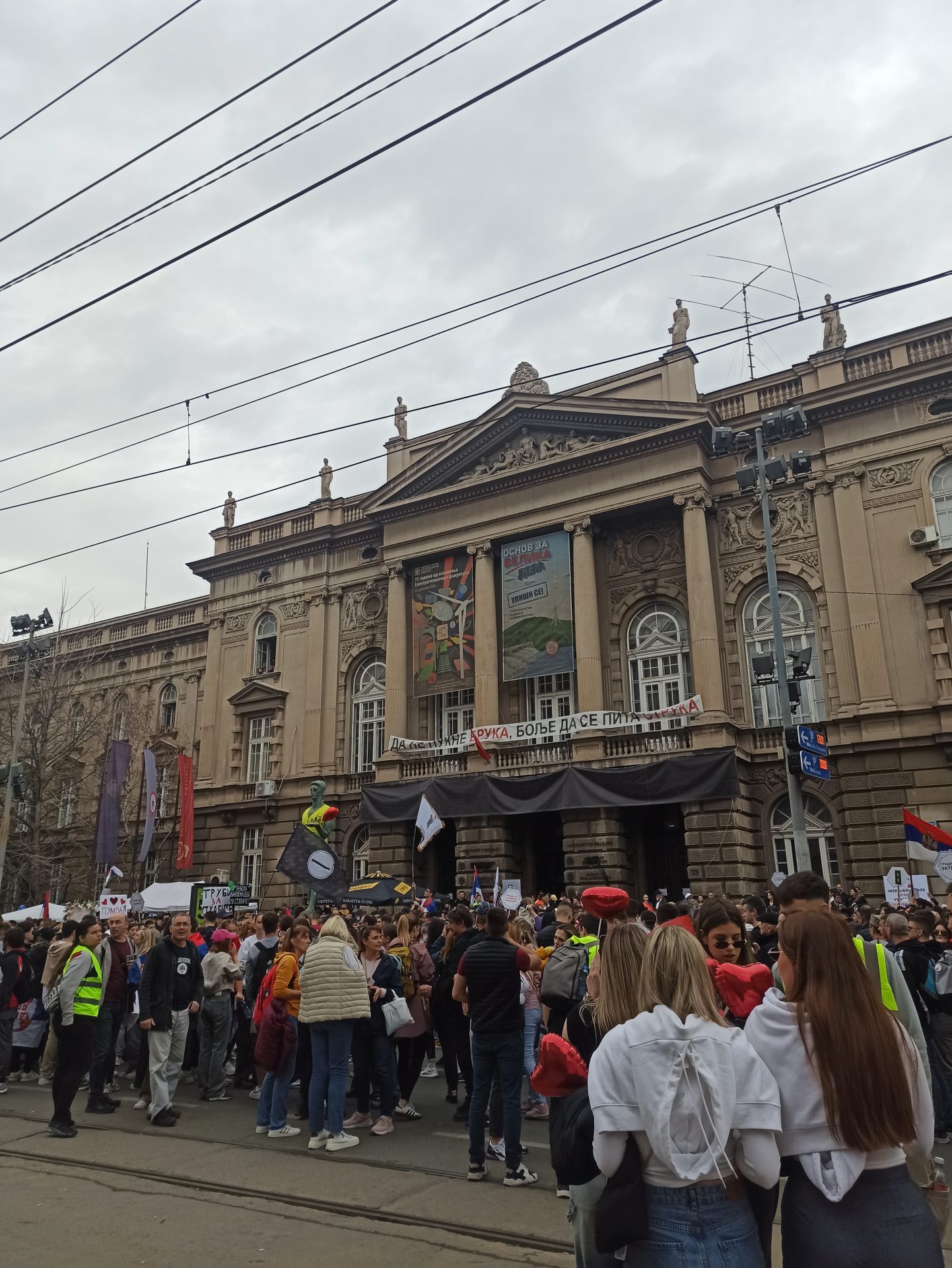 Citizens gathered near the Faculty of Electrical Engineering in Belgrade during the mass protest of 15 March 2025, one of the largest public demonstrations in Serbia’s recent history, with independent estimates exceeding 300,000 participants.