
By the Balkan Civil Society Development Network (BCSDN)
The latest BTI 2026 Regional Report for East-Central and Southeast Europe paints a picture of a region defined by “tested resilience.” While the Western Balkans continue to show remarkable endurance amid post-pandemic recovery and geopolitical shifts, the findings reveal a stark divergence between those advancing toward European standards and those sliding toward authoritarianism. For the civil society, the report serves as both a roadmap for advocacy and a warning siren.
The Democratic Divergence: Stars and Stagnation
The report highlights a widening gap in political transformation across the Western Balkans.
-
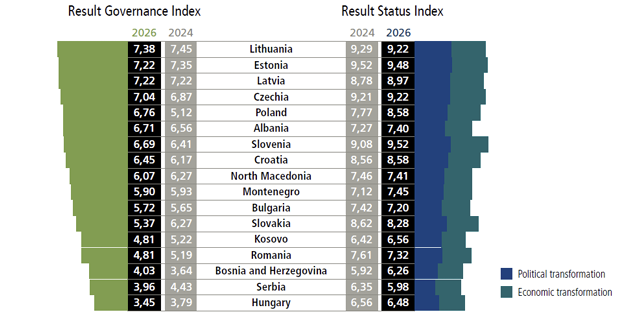
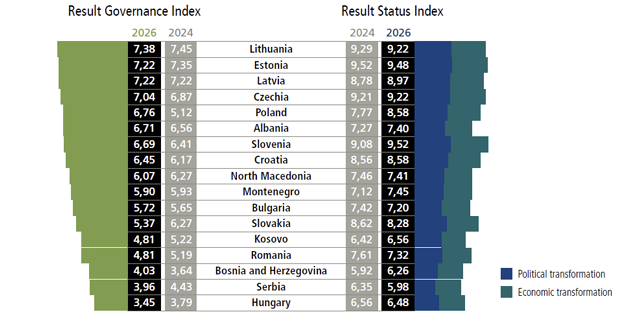
Albania emerges as the region’s non-EU leader, reaching its highest democracy score since 2006. Reforms targeting organized crime and law enforcement have bolstered the rule of law, placing Albania ahead of even some EU member states in democratic status.
-
Montenegro has regained momentum, overtaking North Macedonia as the EU accession frontrunner. The adoption of anti-corruption legislation and judicial reforms led to the EU’s long-awaited Interim Benchmarks Assessment Report (IBAR) in 2024.
-
Serbia, however, presents the most alarming trend. It has officially descended into a “moderate autocracy,” dropping out of the “defective democracy” category due to escalating electoral irregularities and a sustained decline in media freedom and the rule of law.
-
Bosnia and Herzegovina remains a “highly defective democracy,” where progress is hampered by secessionist threats from Republika Srpska. Yet, state-level institutions showed enough resilience for the EU to open accession negotiations in early 2024.
-
North Macedonia finds its trajectory stalled, not by internal reform failures, but by entrenched bilateral disputes with Bulgaria over identity and language that have fueled domestic political shifts.
A Critical Call for Civil Society
The BTI 2026 report underscores that democratic resilience is not guaranteed. In countries like Montenegro, despite progress in reform, civil society remains marginalized in the legislative process, often bypassed by “emergency procedures”. In Serbia, the government’s propaganda apparatus has subjected CSOs and independent media to sustained smear campaigns.
Our Argument: The “Western” orientation of the region is becoming a blurred target. As geopolitical risks grow and some leaders pursue a “balancing strategy” between the EU, Russia, and China, the role of civil society as a watchdog for democratic values has never been more vital. The stability cannot be maintained through domestic political will alone. It requires an active, unencumbered civil society and continued, principled external support to ensure that the “resilience” of the Western Balkans leads to genuine democratic consolidation, not just the survival of the status quo.
This article is based on the data and analysis of the BTI 2026 Regional Report: East-Central and Southeast Europe, authored by Allan Sikk and published by the Bertelsmann Stiftung.