
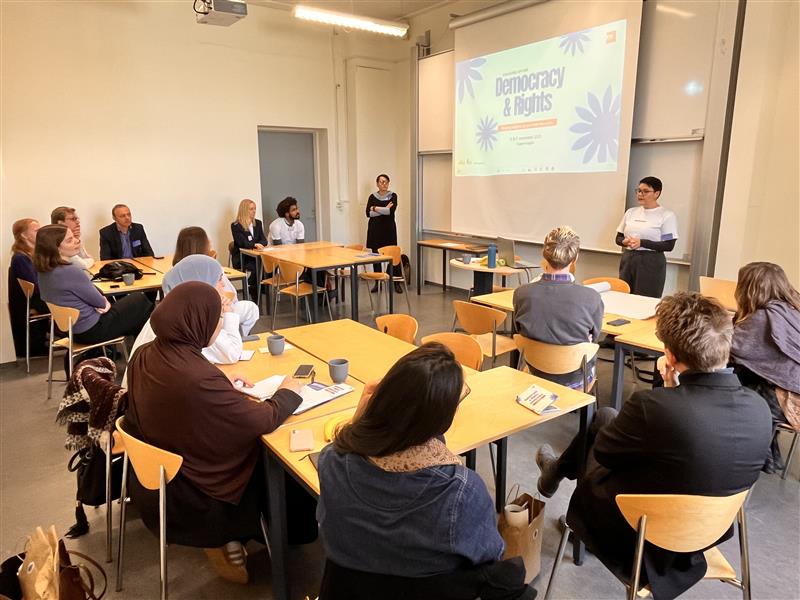
At the 2025 Democracy & Rights Conference in Copenhagen, hosted by Nyt Europa and Global Focus, and held during the Danish EU Presidency, the Balkan Civil Society Development Network (BCSDN) presented an interactive Skill and Capacity Lab titled “From Civic Space Struggles to EU Impact: Advocacy Pathways and Alliances for Civil Society in Europe.” The session was led by Maja Stojanović, Executive Director of BCSDN member organization Civic Initiatives (Serbia), and Simona Mladenovska, Policy and Advocacy Officer from BCSDN’s Executive Office.

The workshop explored strategic avenues for civil society actors across Europe, including both EU Member States and enlargement countries, to engage meaningfully with EU institutions to defend civic space and reinforce democratic values. Drawing extensively on BCSDN’s comprehensive regional monitoring and long-standing advocacy experience, the discussion emphasized how sustained evidence-gathering and coordinated networking can enhance credibility, build alliances, and shape EU policymaking processes.

Using Serbia as a detailed case study, the session traced the gradual erosion of civic space and democratic standards over recent years. This deterioration did not occur abruptly but resulted from a prolonged weakening of institutional protections and democratic norms. The session described the “collapse of the canopy” as a critical turning point, revealing the deeper, systemic nature of civic space restrictions that had been developing largely below the surface. This breakdown exposed vulnerabilities in democratic governance and underscored the urgent need for coordinated advocacy.
BCSDN’s continuous, rigorous monitoring has provided an essential evidence base that enables partners to demonstrate clearly Serbia’s ongoing divergence from fundamental European democratic principles. The session highlighted the European Parliament’s most recent resolution on Serbia, the strongest to date, as a tangible outcome of well-orchestrated advocacy work rather than an impromptu response. Success factors included identifying and engaging key allies within the European Parliament and broader EU institutions, collaborating effectively with EU-based organizations, and delivering timely, strategically framed messages tailored to the priorities of different institutional stakeholders.

A central insight from the workshop was that impactful advocacy requires framing civic space challenges in ways that resonate with each interlocutor’s policy agenda to maintain relevance and drive influence. The discussion reaffirmed that networked advocacy, rooted in long-term monitoring, regional solidarity, and evidence-backed messaging, remains indispensable for advancing EU action on civic space.
The Serbia example clearly illustrates how national democratic challenges can be elevated into shared European priorities when addressed through coordinated regional efforts. This approach strengthens the collective response to civic space restrictions across the continent.
Finally, the session underscored the critical importance of including representatives from non-EU civil society organizations in such forums. This inclusivity ensures they stay informed about EU-level developments and leverage emerging engagement opportunities. Moreover, it fosters the exchange of experiences, particularly concerning democratic backsliding within EU Member States, a shared challenge for many CSOs in the Western Balkans and accession countries. This cross-border dialogue supports the identification of effective resilience strategies and enhances civil society’s collective capacity to counteract shrinking civic space.