
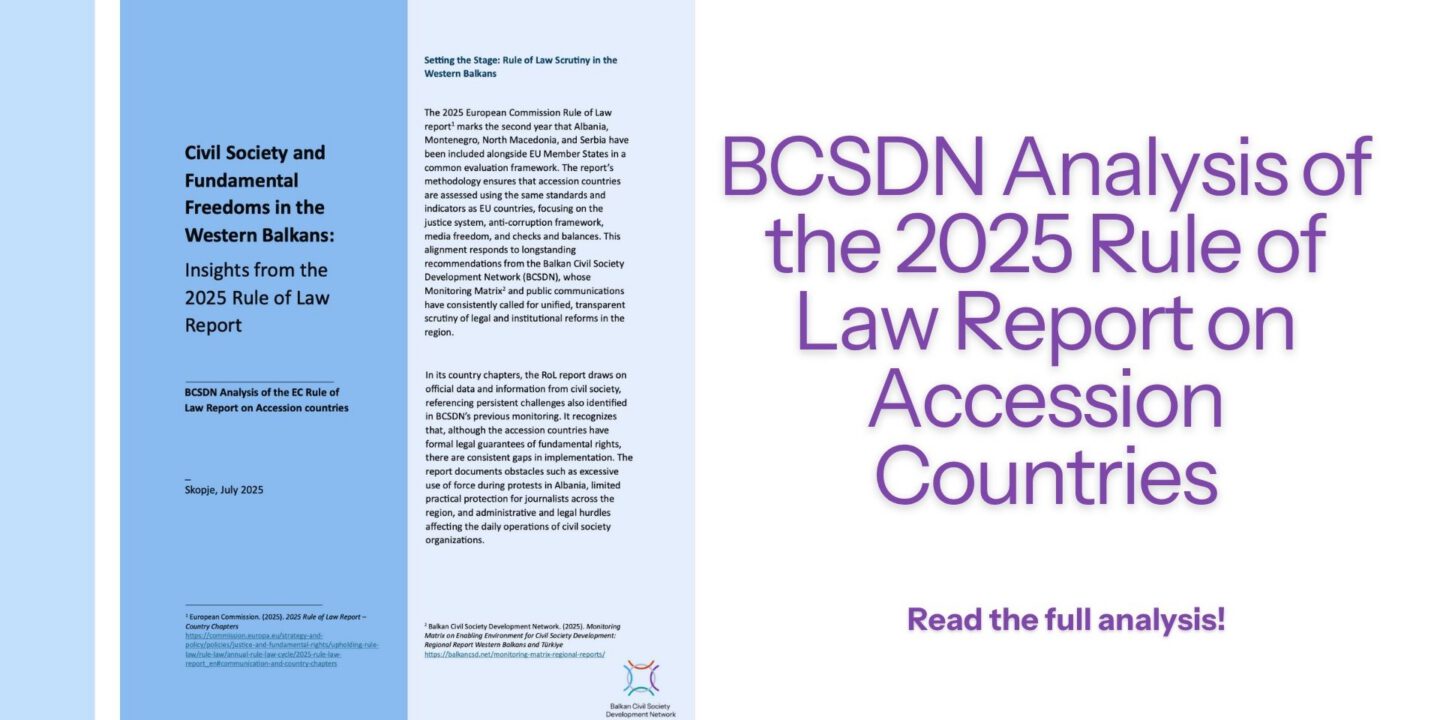
The 2025 European Commission Rule of Law (RoL) report confirms persistent challenges for civil society and fundamental freedoms in Albania, Montenegro, North Macedonia, and Serbia. This year’s report applies the same assessment standards to these accession countries as to EU Member States, a long-standing recommendation from the Balkan Civil Society Development Network (BCSDN) analysis.

Key Takeaways
Civic Space Under Pressure
While formal legal guarantees for fundamental rights exist in accession countries, there are consistent gaps in their practical implementation. The report, aligning with BCSDN’s analyses, highlights issues such as legal intimidation, increased Strategic Lawsuits Against Public Participation (SLAPPs), and political influence over civil society funding and decision-making. Unlike most EU Member States with open civic spaces, Western Balkan countries face systemic pressures, including administrative hurdles, restrictions on activists and journalists, and new restrictive legislation. Specific concerns include spyware misuse in Serbia, burdensome registration in Albania, transparency issues in Montenegro, and online hate speech in North Macedonia.
Fundamental Freedoms Tested
The report documents ongoing difficulties in realizing fundamental rights in practice. This includes disproportionate measures against protests, such as excessive force and arbitrary detentions. Civil society organizations (CSOs) face significant administrative barriers in registration and accessing public funding, often encountering a lack of transparency and delays. Media freedom is threatened by legal intimidation tactics like the criminalization of defamation and SLAPPs. Formal dialogue mechanisms between government and civil society exist but often lack meaningful influence, serving as procedural formalities.
Financial and Operational Challenges
CSOs in the region face multiple challenges undermining their financial viability and operational continuity. Public funding is often unpredictable, insufficient, and politicized. While foreign funding is crucial, reliance on external donors creates vulnerabilities, exacerbated by legislative measures that can restrict or stigmatize such support. Inconsistent tax regimes and insufficient support for CSO economic activities further limit diversified income sources.
Recommendations for Sustainable Reform
The report and BCSDN’s analysis underscore the need for comprehensive efforts to improve the environment for civil society and media. Key recommendations include:
- Strengthening Legal Frameworks: Ensuring genuine protection of freedoms of association, assembly, and expression, and removing administrative hurdles for CSOs.
- Ensuring Financial Sustainability: Fostering transparent and equitable public funding, safeguarding access to international grants, and promoting diversified income for civil society.
- Enhancing Government-Civil Society Dialogue: Making consultations timely, accessible, and inclusive, with active incorporation of civil society feedback into policymaking.
- Protecting Civic Space: Respecting human rights during protests and addressing misuse of surveillance technologies.
- Safeguarding Media Freedom: Reforming restrictive laws and reinforcing protections against harassment of journalists.
- Reinforcing Institutional Independence: Ensuring transparency and freedom from political influence for bodies overseeing funding, consultations, and civic space protections22.
These steps are vital to ensure democratic standards are upheld in practice across the Western Balkans.