
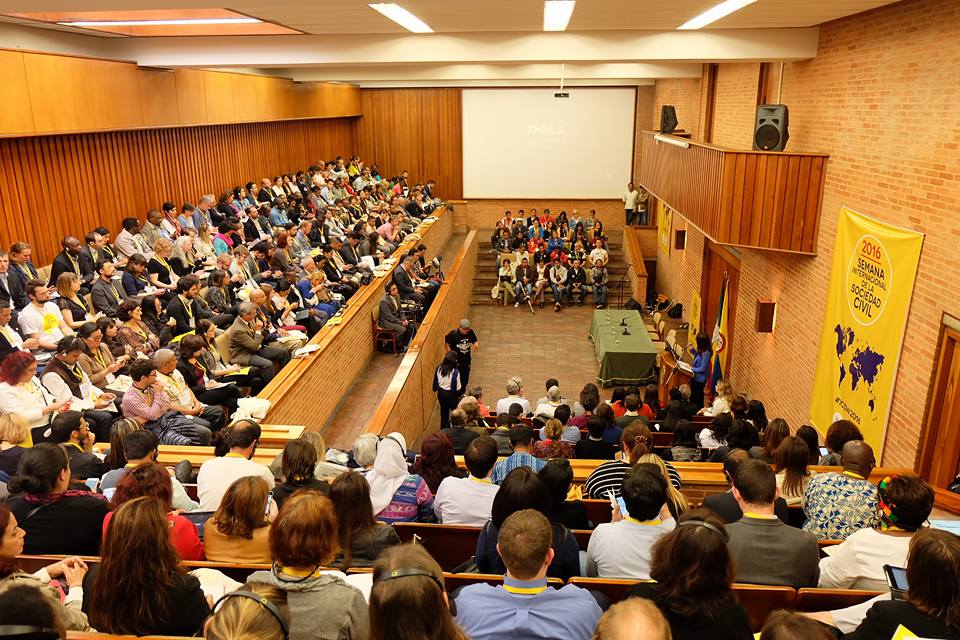
About 900 civil society leaders and activists from more than 109 countries were in Bogota to discuss active citizenry and how to overcome threats faced by civil society groups during the International Civil Society Week 2016 that started on April 25. This was the largest and most diverse gathering of its kind and the first one held in Latin America. The meeting was a space for leaders, activists, representatives of civil society organizations to join together and give their contribution to ensure the respect of rights of association, participation, expression and access to information, and to remind international actors of the role that civil society has as a political and social actor as well as responsible actor in the development sector. Ali Zeddini, of the Tunisian Human Rights League, a prominent human rights activist and 2015 winner of the Nobel peace prize, was among the speakers at the event.
BCSDN took active participation in the week by being part of the two workshops organized by the Global Standard for CSO Accountability, an initiative that the network has recently joined. The first event focused on the increasing pressure to prove “good CSO accountability” in a rapidly changing environment and what are the core elements that CSOs can all agree on, and, with increasing government intervention, eroding public trust and ever more demands on CSO time, how can a Global Standard of good accountability make civil society work easier and increase its effectiveness and efficiency? This participatory session addressed key questions from the Global Standard Project Partners’ perspective, providing space for others to contribute.
The second event was called: CSO Self-Regulation Versus External Control: The Relevance and Contributions from a Global Standard Developed from Civil Society to Resolve This Tension and it was organized by the Global Standard for CSO Accountability, together with Iniciativa Regional Rendir Cuentas and CCONG. The discussion aimed to understand the relevance and opportunities for a Global Standard for CSO accountability to be recognized and used by public officials and officers of cooperation as a basis for preparing and/or improving the regulatory frameworks and due diligence which are being developed for civil society organisations in Colombia or wider. A conversation among key actors in the definition of regulatory mechanisms of CSOs addressed questions such as: what should the different proposals for regulation of accountability of the CSOs seek?; what are the benefits and the difficulties of accountability mechanisms of the CSOs when these arise from self-regulation or when these arise from the decision of an external actor such as the government?; to what extent these two sources of regulation face off against each other or may be complementary? and is it useful for all stakeholders regulating the management of CSOs to count on a Global Standard for CSO accountability, developed from the same civil society to resolve this tension?
BCSDN representative Ilina Nesik also participated at other various events during the week, for ex. the presentation of the Civic Space Monitor were BCSDN is to become a regional node. The next generation of CIVICUS research tools aim to offer continuous and up-to-date assessment of civic space. The Civic Space Monitor, a web platform due to be launched in September 2016, combines eight streams of data on civic space to provide a comparative yet context-specific measurement of civic space for every country in the world.
More information on the #ICSW2016 is available here.