
The Balkan Civil Society Development Network (BCSDN) participated in the Civil Society & Think Tank Forum 2026, held from 5 to 7 October in Prishtina, Kosovo, as part of the Berlin Process. Bringing together more than 250 representatives of civil society, think tanks, European institutions, governments and regional organisations, the Forum provided an opportunity to discuss the Western Balkans’ priorities and develop policy recommendations ahead of the Berlin Process Leaders’ Summit in Podgorica on 22 October.
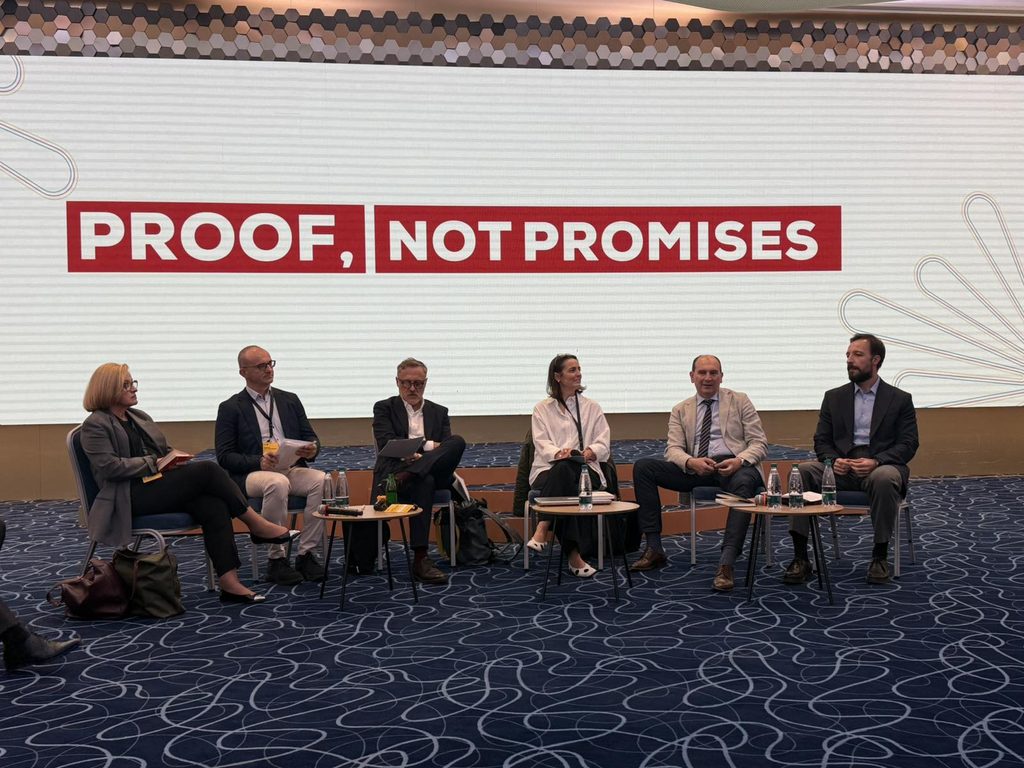
Organised by Open Society Foundations – Western Balkans, in partnership with the Government of Kosovo and in cooperation with the Government of Montenegro, the Forum took place under the theme Proof, Not Promises, emphasising the need to translate political commitments into concrete reforms and results.
Discussions were organised around six thematic areas: competitiveness and growth, digital transformation and artificial intelligence, security and resilience, civic space and democratisation, the green transition, and EU enlargement. Across these discussions, participants examined how regional cooperation and the enlargement process can deliver more tangible benefits while strengthening democratic accountability.
Safeguarding Civic Space and Democracy in the Enlargement Process
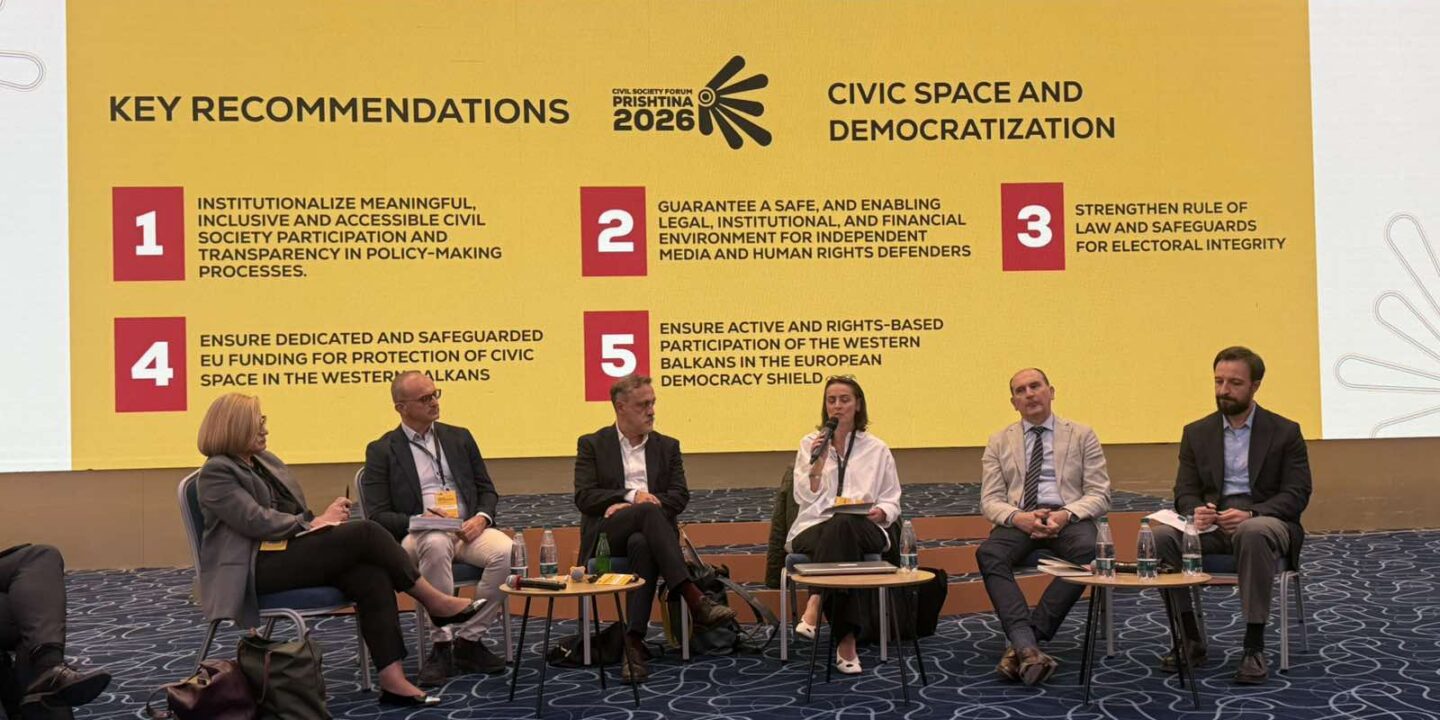
A central discussion for BCSDN was the thematic session “Safeguarding Civic Space and Democracy: From Commitments to Conditionality for a Credible EU Enlargement Process”, held on 6 October.
The session was organised under the leadership of BCSDN member Partners Albania, together with Transparency International Bosnia and Herzegovina, and facilitated by BCSDN Board Chair Klotilda Kosta, Director of Programmes at Partners Albania.
It brought together BCSDN Board member Dren Puka, Executive Director of the Kosovo Civil Society Foundation (KCSF); Ionuț Sibian, Vice-President of the European Economic and Social Committee’s External Relations Section; Leila Bičakčić, Executive Director of the Centre for Investigative Reporting; Nenad Koprivica, policy expert at CEDEM; and Milorad Bjeletić, General Director of Belgrade Open School.
The discussion addressed growing pressure on civic space across the Western Balkans and its implications for democratic governance and the credibility of EU enlargement. Participants examined the gap between formal commitments to democratic standards and their implementation, particularly where CSOs face restrictions, intimidation or limited opportunities to influence public decisions.
A key message was that the protection of civic space must become a more concrete and enforceable part of the EU accession process, supported by clear benchmarks, consistent monitoring and consequences for democratic backsliding.
Participants also stressed that civil society participation should extend beyond formal consultations. Organisations need opportunities to contribute to policy development, monitor reforms and hold institutions accountable, while maintaining their independence and access to sustainable funding.
BCSDN Executive Director Anja Bosilkova Antovska also attended the Forum, engaging in regional exchanges on the future of civil society and EU enlargement.
From Regional Discussions to Policy Recommendations
The discussions contributed to the Forum’s policy recommendations, developed through thematic working groups and consultations ahead of the event.
The recommendations on civic space and democratisation, prepared by Partners Albania and Transparency International BiH, call for stronger protection of civic freedoms and a more consistent approach to democratic standards within EU enlargement.
They address meaningful civil society participation in policymaking, protection of journalists and human rights defenders, electoral integrity, and dedicated EU funding to support civic space across the region.
These priorities are closely connected to BCSDN’s longstanding advocacy for stronger civic space safeguards, more credible EU monitoring and meaningful civil society involvement in enlargement-related reforms.
The Forum’s recommendations will be brought forward to the Berlin Process Leaders’ Summit in Podgorica on 22 October, providing an opportunity for regional civil society priorities to inform discussions among political leaders.
For BCSDN, the Forum reinforced the importance of connecting evidence on civic space developments with concrete policy commitments and accountability mechanisms, ensuring that the protection of civic freedoms remains central to the Western Balkans’ European integration.