
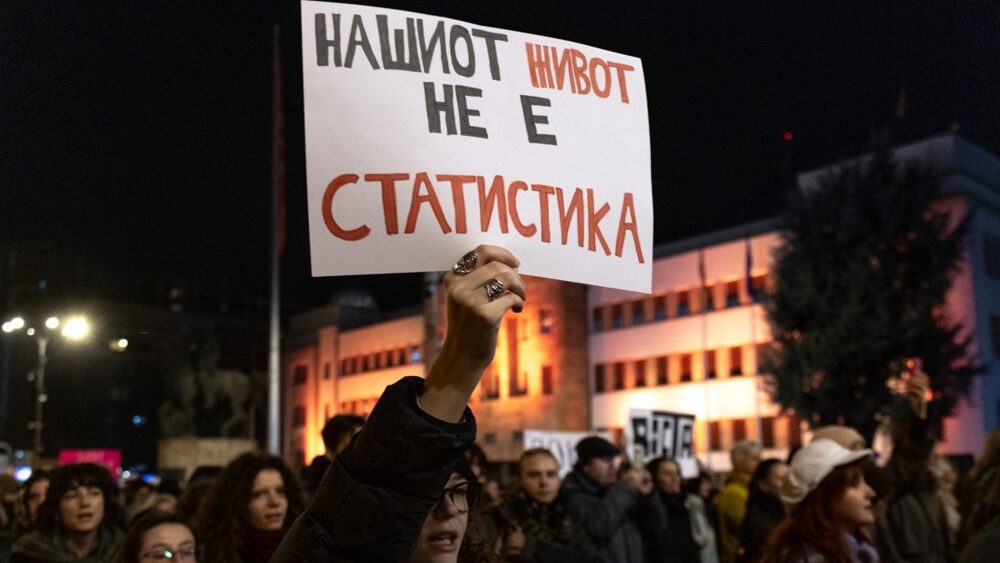
The recent femicides in Kosovo and North Macedonia have sparked protests and renewed calls for institutional accountability and stronger protection of women from violence. Yet, at a time when the work of women’s rights organisations and human rights defenders is most needed, those demanding change are themselves increasingly exposed to threats, smear campaigns and political hostility.
These developments are taking place against a backdrop of growing anti-gender narratives across the Western Balkans and Türkiye, increasingly influencing legislative and policy decisions, public discourse and the enabling environment for civil society. Beyond undermining progress on gender equality, they threaten the ability of civil society to advocate for rights, hold institutions accountable and provide essential services.
Are we witnessing the early signs of a more systemic rollback of women’s rights and the civic space in which these rights are defended? How can further deterioration be prevented?
Civil society raising the alarm
Within two weeks this autumn, two women who had repeatedly asked the institutions for protection were killed: 49-year-old Arlinda Zekaj in Kosovo and 17-year-old Biljana Kirikj in North Macedonia. Both cases exposed shortcomings that women’s rights organisations have documented for years: hostile narratives, inadequate risk assessments, ineffective enforcement of protection orders and weak institutional coordination. Neither case was isolated, with growing number of femicides and similar failures documented across the region.
Civil society organisations have been instrumental in documenting these failures, supporting survivors, mobilising citizens and advocating for systemic reforms. Many of their concerns are also reflected in the European Commission’s 2026 Enlargement Report, both for Kosovo and North Macedonia. Yet, despite longstanding civil society recommendations and repeated warnings, institutional responses remain inadequate. At the same time, the environment in which these organisations operate is becoming increasingly hostile.
From political rhetoric to legislative setbacks
Beyond persistent institutional failures in addressing violence against women, growing anti-gender movements is increasingly undermining efforts to strengthen the legislative and policy frameworks needed to prevent it.
In North Macedonia, the draft Law on Gender Equality remains unadopted following the 2023 mobilisation against it, led by the Orthodox church. That same year, the municipality of Strumica annulled its memoranda with LGBTI organisations. More recently. amendments to the legislation on violence against women have reportedly stalled over opposition to the use of “too progressive” gender-related terminology.
Similar pressures have shaped education policies. In 2025, following campaigns by anti-gender groups, content on gender equality, contraception and gender-based violence content has been removed from the revised educational programme. HERA and the Platform for Gender Equality have warned against the consequences of such decisions, while the European Commission has also raised these concerns in its 2026 Report.
These developments are accompanied by political rhetoric that not only downplays violence against women but also delegitimizes those advocating against it. Following the march on 20 November against femicide in Skopje, a leader of a ruling coalition party described protesters as hysterical and foreign-paid, reinforcing familiar narratives used to discredit independent civil society, and defended husbands’ control over their wives on national television. Bishop Jakov of Stobi also characterised the demands of three women’s rights networks as an ideological ultimatum in the name of the victims.
Such developments demonstrate how anti-gender narratives can move beyond public discourse, influence institutional decisions and undermine both human rights protections and the advocacy efforts of civil society.
An increasingly unequal enabling environment
The influence of anti-gender narratives is also evident in the conditions under which civil society actors operate, particularly in their access to public resources and decision-making processes. BCSDN’s regional research, The Missing Lens: Rethinking the Enabling Environment for Gender Equality and Civil Society in the Western Balkans, documents how women’s rights and LGBTIQ+ organisations face systemic barriers to their work, including unequal access to resources, limited participation in decision-making and gender-specific forms of intimidation.
Recent developments reinforce these findings. Organisations providing specialised services and advocating for gender equality continue to face insufficient and unpredictable funding and limited opportunities for meaningful institutional engagement. In Kosovo, the European Commission’s report notes that inconsistent government consultation has weakened women’s rights organisations’ role in lawmaking and monitoring.
Meanwhile, groups campaigning against gender equality are not only receiving public funding, which is ironically earmarked for gender equality, but are also gaining institutional recognition and access to decision-makers. In North Macedonia, this has included participation in parliamentary hearings, meetings with senior officials and access to publicly provided premises.
The concern is not the participation of different groups in public debate, but the increasingly unequal conditions under which civil society actors operate, particularly when anti-gender groups are being treated as legitimate stakeholders, while organisations defending fundamental rights face delegitimisation, exclusion and hostility.
Silencing those who raise the alarm
The recent protests have also exposed the particular risks faced by women human rights defenders. In Kosovo, feminist activist Anita Nikaj has faced death and rape threats online, reportedly escalating into physical intimidation. QIKA’s Executive Director, Leonida Molliqaj, has been subjected to online harassment and attempts to discredit her feminist engagement by attributing partisan political motives to her activism. In North Macedonia, women’s rights organisations have been publicly targeted over their foreign funding and accused of exploiting victims for political purposes.
These attacks reflect a common pattern of delegitimising independent civic engagement by portraying activists as serving foreign, partisan or ideological interests. The European Commission’s 2026 reports also identify hate speech and threats against women human rights defenders in North Macedonia, particularly online, and highlight the need to follow up on reports of political figures targeting human rights defenders in Kosovo.
Across the region, gender-specific attacks extend beyond organisations working on gender equality. In Montenegro, after Vanja Calović of the anti-corruption watchdog MANS exposed electoral fraud, a pro-government tabloid published fabricated pornographic images attributed to her. In Serbia, student activist Nikolina Sinđelić was beaten and threatened with rape by a police commander after her arrest at a 2025 protest; intimate photos of her were then shared online without her consent. In Bosnia and Herzegovina, Banja Luka Pride organisers were violently attacked after senior political officials called for the event to be cancelled.
Such attacks raise the personal and organisational costs of civic engagement, discourage public participation and risk silencing those who challenge institutional failures. Their gender-specific nature must be recognised as a distinct dimension of civic space deterioration.
Reading the signals early
Developments in Türkiye illustrate how anti-gender narratives can translate into increasingly severe restrictions on civil society. Following the country’s withdrawal from the Istanbul Convention in 2021 and the government declaring 2026-2035 a “Decade of Family and Population”, growing political hostility towards gender equality and LGBTIQ+ rights has been accompanied by raids, detentions and blocking orders that spread to women’s organisations, with at least three associations now facing dissolution.
While national contexts differ, these developments underscore the importance of recognising how hostile narratives, legislative setbacks, unequal institutional treatment and attacks on activists can accumulate and reinforce one another. Developments that may appear isolated when assessed individually can, when viewed together, reveal emerging patterns of systemic civic space deterioration.
Through its Monitoring Matrix and the Regional Civic Space Early Warning System and Response Mechanism, BCSDN seeks to identify precisely such patterns and strengthen the link between independent civil society evidence and timely institutional responses. Recognising the gender dimension of civic space restrictions is essential to these efforts. Monitoring must capture not only formal restrictions on civil society but also the discriminatory practices, hostile narratives and informal pressures that undermine its ability to operate freely and effectively.
From warnings to action
BCSDN stands in solidarity with women’s rights organisations and human rights defenders across the region and joins their calls for institutional accountability and effective protection from gender-based violence.
We call on national authorities to:
- Ensure an enabling environment for women’s rights and gender equality organisations, including sustainable and non-discriminatory funding and meaningful participation in policymaking.
- Refrain from rhetoric that delegitimises civil society and promptly investigate and publicly condemn threats and attacks against human rights defenders, recognising their gender-specific nature.
- Prevent the rollback of gender equality and human rights frameworks and ensure that legislative and policy decisions are grounded in human rights standards and civil society expertise.
We call on the European Union and international stakeholders to:
- Recognise anti-gender narratives and gender-specific attacks on civil society as indicators of civic space deterioration and address them systematically within existing monitoring and protection mechanisms.
- Ensure that independent civil society evidence informs timely political dialogue, preventive engagement and concrete institutional responses, including within EU enlargement processes by following up systematically on the Enlargements reports.
- Provide sustainable support to women’s rights organisations and human rights defenders, recognising their essential contribution to democratic resilience and the protection of fundamental rights, in line with the European Democracy Shield’s commitments to civil society protection.
Women’s organisations across the region have long identified shortcomings in institutional protection and warned of emerging threats to fundamental rights. Preventing further deterioration requires institutions to act on this evidence before restrictions become entrenched.
Protecting civic space means protecting those who expose institutional failures, challenge discrimination and demand accountability. The ability of women’s rights organisations and human rights defenders to carry out their work freely and safely is both a prerequisite for advancing gender equality and a measure of the health of democracy across the region.
Photo credit: A woman holds an ‘Our lives are not statistics’ placard at a protest against femicide in Skopje on 25 November 2026. Photo: EPA/Georgi Licovski (Balkans Insight)